India must rethink fire risk, ventilation, and heat exposure before the next incident
Every summer, temperatures rise. But now, fire incidents rise with them.
Across India, the pattern is becoming impossible to ignore. With 95 of the world’s 100 hottest cities currently located in India (Ref), and many locations exceeding 45°C, industrial environments are operating under conditions they were never originally designed for.
What we are witnessing today is not a string of unrelated accidents. It is a systemic safety warning.
When summer heat turns normal operations into Unsafe Conditions
In recent weeks, multiple industrial fire incidents have been reported across the country: chemical facilities, manufacturing units, storage areas, and high‑value infrastructure projects.
One serious example involved a chemical manufacturing facility located in a major industrial estate in western India, where a large fire erupted around 1:00 PM, the hottest part of the day.
- More than a dozen workers were injured
- Thick smoke was visible from a long distance
- Emergency response systems were activated, but the fire spread rapidly
The timing matters. Midday, peak heat, summer conditions- this detail is not incidental; it is central to understanding the risk pattern.
A repeating pattern we can no longer treat as coincidence
When recent fire incidents are reviewed together, a clear summer‑linked pattern emerges:
- Fires occur late morning to afternoon
- Most involve chemicals, polymers, or flammable materials
- Ambient temperatures are extremely high
- Ventilation struggles to remove accumulated heat
- Systems operate closer to failure thresholds
This tells us something uncomfortable but necessary:
Extreme heat is no longer a background condition, it is an active hazard.
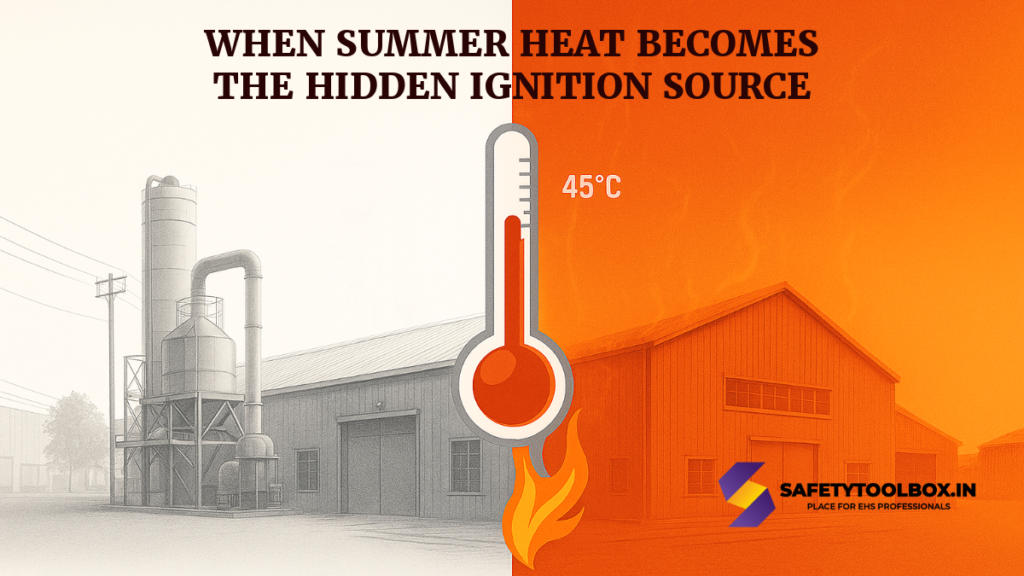
The Hidden role of Heat transfer in summer fires
Many investigations focus on spark, short circuit, or process deviation. These are important, but incomplete explanations.
Summer adds three invisible stress factors that often go unaddressed:
1. Conduction – Silent Heat build‑up
Metal structures, electrical panels, pipelines, and cable trays absorb heat from the surrounding environment. When daytime temperatures remain high for long hours, components never fully cool, leading to insulation degradation and mechanical fatigue.
2. Convection – Hot air that doesn’t escape
Hot ambient air enters process areas and circulates repeatedly when ventilation is weak or poorly designed. Instead of cooling equipment, air movement spreads and traps heat-especially in enclosed spaces.
3. Radiation – Solar heat from outside the process
Roofs, tanks, and walls exposed to direct sunlight can reach 65–70°C. This radiant heat steadily raises the temperature of stored chemicals and equipment, without any change in process parameters.
Together, these heat mechanisms push systems closer to ignition limits, even when operations appear “normal.”
Why Process Safety alone is no longer enough
Most industrial facilities are designed around process safety principles:
- Safe operating temperatures
- Pressure limits
- Reaction controls
- Emergency shutdown systems
But summer fire incidents reveal a gap.
Ambient heat, solar load, and ventilation stress are often outside traditional design thinking.
Yet these factors directly affect:
- Vapour pressure
- Material stability
- Electrical reliability
- Human performance
Ignoring them means designing plants for a climate that no longer exists.
Fire incidents are not just safety failures – They are economic losses
A single large summer fire can result in:
- Damage worth thousands of crores
- Shutdowns lasting weeks or months
- Job losses and contractor uncertainty
- Insurance delays and litigation
- Missed customer commitments
Recent incidents have shown how years of investment can be destroyed within hours, impacting not just companies but regional and national economic growth (Time of India)
When fires become frequent, they:
- Slow manufacturing momentum
- Reduce investor confidence
- Increase insurance costs
- Delay critical infrastructure
Fire safety, therefore, is not only a compliance issue, but also a growth issue.
The Safety question we must ask ourselves
Are today’s fire protocols designed for:
- 45°C+ ambient temperatures?
- Continuous thermal stress?
- Heat‑fatigued human response?
- Simultaneous electrical and ventilation overloads?
If the answer is “no,” then compliance alone is not protecting people.
A new safety direction for Indian Industry
To address the summer fire pattern, industries must shift mindset from incident response to heat‑aware prevention.
1. Design with heat reality in mind
- Assume extreme heat as a normal operating condition
- Use heat‑rated cables, insulation, seals, and enclosures
- Protect roofs, tanks, and walls from direct solar radiation
2. Treat ventilation as a Safety barrier
Ventilation is not comfort it is risk control.
- Design airflow to remove heat buildup
- Prevent hot air recirculation
- Prioritize electrical rooms, storage areas
3. Introduce summer‑specific safety audits
Generic annual audits are not enough. Summer audits should assess:
- Thermal stress points
- Electrical load during peak heat
- Equipment clustering
- Human error risk under heat fatigue
4. Integrate heat into emergency planning
Peak‑heat emergencies demand:
- Faster detection
- Shorter response time
- Clear evacuation routes
- Rested, trained response teams
Safety is a system, not a checklist
Recent industrial fires including chemical facility blazes, factory explosions, and high‑value infrastructure incidents are not warnings to ignore.
They are signals. Signals that tell us:
- Our climate has changed
- Our risk profile has changed
- Our safety thinking must change too
Final Thought: Heat must become a design and safety parameter
India’s summer heat is no longer seasonal discomfort; it is a persistent safety hazard.
If industries continue to design plants only around processes, and not around heat, ventilation, and climate stress, fires will continue to:
- Injure workers
- Destroy wealth
- Slow economic progress
The lesson is clear:
The safest plant tomorrow is the one designed today for extreme heat.
The pattern is visible.
The science is known.
What remains is the will to rethink safety—before the next incident makes the headline.
References (for transparency and further reading)
Incidents in the Month of May – Last 2–3 Years
- Chemical factory fire with injuries and timing details (News18):
https://www.news18.com/india/at-least-16-injured-in-massive-blaze-at-chemical-factory-in-gujarats-bharuch-ws-l-10053054.html - India among the world’s hottest cities (National Herald):
https://www.nationalheraldindia.com/environment/india-dominates-global-heat-chart-with-95-of-worlds-100-hottest-cities - Large‑scale industrial fire damage and economic loss (Times of India):
https://timesofindia.indiatimes.com/city/nashik/fire-leaves-jindal-plant-with-damage-worth-2k-cr/articleshow/121374858.cms - Resurgence of serious fire incidents in India (News18):
https://www.news18.com/india/two-days-two-separate-fire-tragedies-around-50-deaths-take-a-look-at-recent-fire-incidents-in-india-8904795.html - High‑value infrastructure fire incident (National Herald):
https://www.nationalheraldindia.com/national/rajasthan-fire-incident-at-rs-80000-crore-pachpadra-refinery-ahead-of-inauguration-by-pm-modi
Read our latest interesting article on Distraction safety
For regular updates on safety topics or videos follow us on LinkedIn
for more safety toolbox talk click here…